If you have ever asked what is a graphic novel, here is the short answer: a book-length comics story sold as a book, not a pamphlet. The label is looser than it sounds.
This explainer is part of the wider guide to london comics culture, an independent look at comics in the capital.
| Item | Value |
|---|---|
| Term first used in print (Richard Kyle, Capa-Alpha) | November 1964 |
| Will Eisner’s A Contract with God | 1978 |
| Start of the Marvel Graphic Novel line | 1982 |
| Maus wins a Pulitzer Prize | 1992 |
| Book Industry Study Group adds a graphic novel category | 2001 |
| Comic books in periodical pamphlet form | Circulating since the 1930s |
These dates come from EBSCO Research Starters and Wikipedia’s graphic novel entry. Historical dates can be revised as researchers dig deeper, so check the sources before you rely on them.
The short definition, and why it gets fuzzy
Dictionaries agree on the basics. Merriam-Webster’s definition of a graphic novel is “a fictional story that is presented in comic-strip format and published as a book”, as Wikipedia reports. The Oxford English Dictionary, quoted by the University of Maryland Libraries, gives “a full-length (esp. science fiction or fantasy) story published as a book in comic-strip format”.
Everyday use is wider than either definition. According to EBSCO Research Starters, the label means different things depending on who is speaking:
- The book trade: any non-periodic book featuring comics.
- Academia: auteur comic-strip narratives produced outside mainstream periodical comic books.
- Casual talk: occasionally a plural synonym for “comics”.
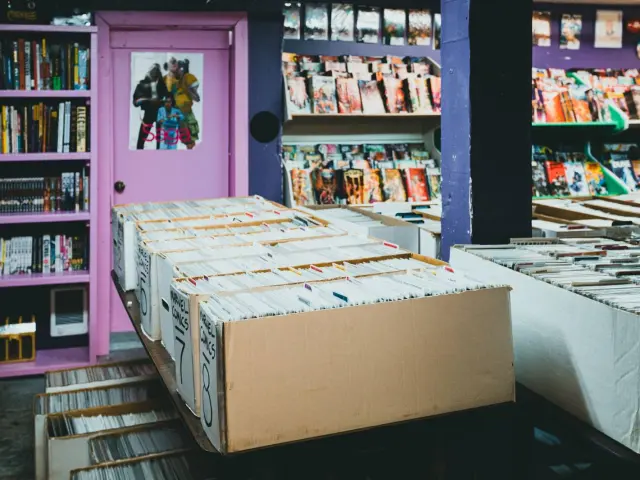
Shops stretch it further still. Wikipedia notes that libraries and bookstores stock anthologies, loosely related collections and even non-fiction as graphic novels.
How is a graphic novel different from a comic book?
The clearest split is format. Comic books are periodical pamphlets that have circulated since the 1930s, while the graphic novel label was co-opted to describe usually expensive, high-production-value books designed for bookstores instead of newsstands, as EBSCO Research Starters explains.
| Feature | Comic book | Graphic novel |
|---|---|---|
| Format | Periodical pamphlet | Non-periodic book |
| Aimed at | Newsstands | Bookstores |
| Story shape | Often part of an ongoing series storyline | Meant to be read as one story |
The line is not tidy. Wikipedia says the term is also used to separate works created as standalone stories from compilations of a story arc, yet shops also stock collections that do not form a continuous story under the same label.
Stephen Weiner’s umbrella definition, quoted by the University of Maryland Libraries, covers book-length comic books meant to be read as one story. It includes collections meant to be read apart from their ongoing comic book storyline.
The book format was not new to every market. In francophone Europe, EBSCO Research Starters says book-form comics called albums had become the high-end segment of publishing, with series such as Les Aventures de Tintin.
Where the term came from
The words first appeared in November 1964, when fan writer Richard Kyle used them in the newsletter Capa-Alpha, according to EBSCO Research Starters. Paul Gravett adds that Kyle was dissatisfied with the limiting word ‘comics’ and wanted to instil greater ambition in creators and publishers.
The idea stayed inside fandom for a while. By the mid-1970s it had become a catchword in the book trade, and books were described as graphic novels in their editorial blurbs in 1976, per EBSCO Research Starters.

Will Eisner’s A Contract with God (1978) is the book that gave the term traction. The University of Maryland Libraries guide points out that it was in fact a collection of stories, not a novel, and that Eisner later discovered he was not the first to use the term. Wikipedia adds that the term gained popularity after that book and the start of the Marvel Graphic Novel line in 1982.
The wider public caught on in the late 1980s. Wikipedia credits the commercial successes of the first volume of Maus in 1986, the collected edition of The Dark Knight Returns in 1986 and Watchmen in 1987. EBSCO Research Starters highlights Maus winning a Pulitzer Prize in 1992 as a sign of recognition from literary award bodies.
Long-form picture stories are much older. Wikipedia calls The Adventures of Obadiah Oldbuck the oldest recognized American example of comics used to this end, and notes it was first published in English translation in 1841 by London’s Tilt & Bogue.
Why many comics creators dislike the label
Art Spiegelman, creator of Maus, a two-volume memoir-in-comics, once explained that he had been interested in making a comic book that would require a bookmark. He has nonetheless admitted a beleaguered acceptance of the term, saying “The Faustian deal is worth making: it keeps my book in print,” according to the essay in Keywords for Comics Studies.
EBSCO Research Starters notes that some creators criticize the term as overly commercial or pretentious. Paul Gravett lists the usual complaints:
- It overpromises: plenty of graphic novels are not novels at all, nor novellas, but short stories at best.
- It sounds snobbish: he quotes cartoonist Jules Feiffer as saying “I hate the term ‘graphic novel’.”
- It has a second meaning: ‘graphic’ can also mean shocking and explicit, which a good many are.
There is a pointed irony here. Gravett records that Chris Ware was awarded The Guardian’s First Novel Prize for Jimmy Corrigan in 2001, and the University of Maryland Libraries guide says even Eisner considered the term very limited, preferring “graphic literature” or “graphic story”.
How to tell what you are holding in a shop
No label is perfect, but a few checks help. They draw on the format split described by EBSCO Research Starters.
- Look at the format: a periodical pamphlet leans comic book, a non-periodic book leans graphic novel.
- Ask whether it is meant to be read as one story or as an instalment of an ongoing series.
- Treat the shelf label with care, because anthologies and non-fiction are often stocked as graphic novels too.
A good next step is british comic book characters, which looks at figures from British comics. You can follow the production side of the medium in how comic books are made.
Frequently asked questions
Is a graphic novel just a long comic book?
Show answer
In practice, often yes, though the label is argued over. Wikipedia describes it as a self-contained, book-length form of comics and notes that applying it broadly is highly contested by comics scholars and industry professionals.
Does a graphic novel have to be fiction?
Show answer
No. Merriam-Webster’s definition says fictional, but the University of Maryland Libraries guide describes today’s graphic novel as book-length sequential art that includes biography, memoir, history and other non-fiction.
Who invented the term “graphic novel”?
Show answer
Fan writer Richard Kyle used it in November 1964, according to EBSCO Research Starters. Eisner popularised it with A Contract with God but was not the first to use it.
Does “graphic” mean the book is explicit?
Show answer
Not necessarily. Paul Gravett points out that the word has an unfortunate second meaning, shocking and explicit, which a good many graphic novels are, so the confusion is understandable.